We will call you within two clinic days (not counting days the clinic is closed). Your appointment is confirmed once we agree on a date and time by phone.
PhD in Medicine (Kyoto University)Medical Director Yutaka Kuroda
A condition in which blood flow to the top of the thighbone, inside the hip joint, decreases and part of the bone dies.
The femoral head is the rounded part of the bone that bears your body weight. If the dead bone collapses, it can lead to hip pain and difficulty walking.
Treatment options vary with the extent and location of the necrosis and the condition of the bone. The first step is to assess your condition.
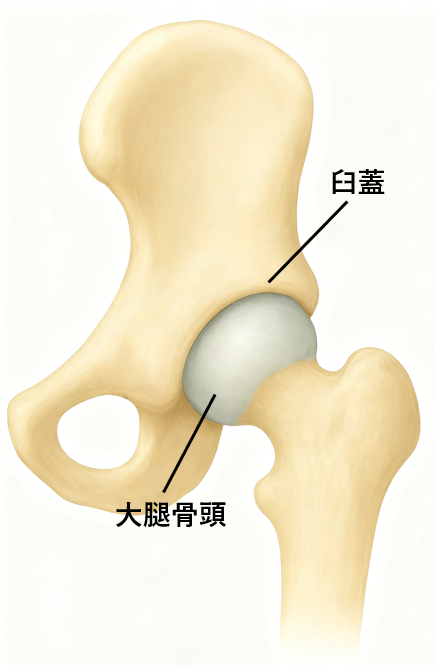
Location of the hip joint and the femoral head (diagram)
02 SYMPTOMS
Does any of this sound familiar?
For anyone dealing with pain in the knee, hip, foot, ankle or other joints, or with questions about treatment.
✓Your hip or other joints hurt every time you walk or stand up
✓Pain persists despite ongoing injections or treatment
✓An MRI has shown bone marrow lesions (BML) or osteonecrosis
✓You'd like to discuss options other than joint replacement
✓Work or family makes it hard to take time off for a hospital stay
✓You want advice so you can keep up your sports or hobbies
These symptoms alone are not enough to diagnose osteonecrosis of the femoral head. The cause is determined through examination and tests.
03 TREATMENT
Treatment options that fit each patient's condition.
Which treatment is right for you depends on your condition. We explain a treatment plan that takes into account your examination and test results, your wishes and your lifestyle.
01Joint Treatment
Joint Injections
We offer joint treatments such as stem cell therapy and PRP (platelet-rich plasma). The doctor decides at your examination which areas and symptoms can be treated and whether a treatment is right for you.
For the knee, hip, foot, ankle and other joints
Culturing the cells for stem cell therapy takes about a month
Regenerative medicine is self-pay (not covered by insurance)
We perform same-day surgery for osteonecrosis of the femoral head, osteonecrosis of the knee, foot or ankle, and osteoarthritis. If a hospital stay would be difficult for you, please talk to us.
Suitability is assessed through examination, imaging and other tests
Results and progress vary from person to person. In some cases, another treatment, such as joint replacement surgery, may be appropriate. Before any treatment, we explain its cost, its risks and how many visits to expect.
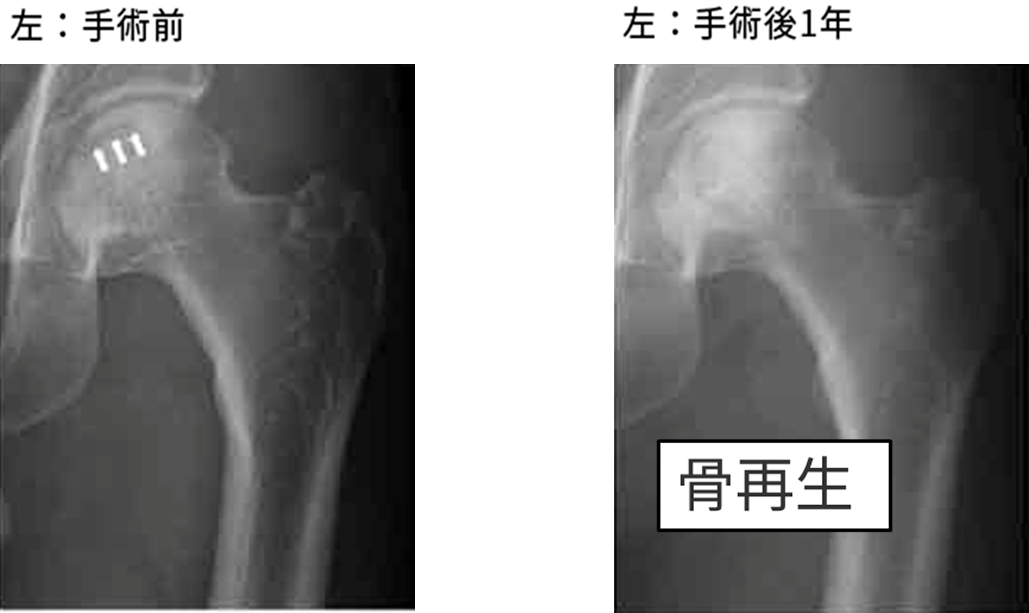
Here is one patient's case, with images: the condition at the first visit and progress after treatment.
CASE 01
Man in his 40s
Osteonecrosis of Both Femoral Heads
1 Year After Surgery
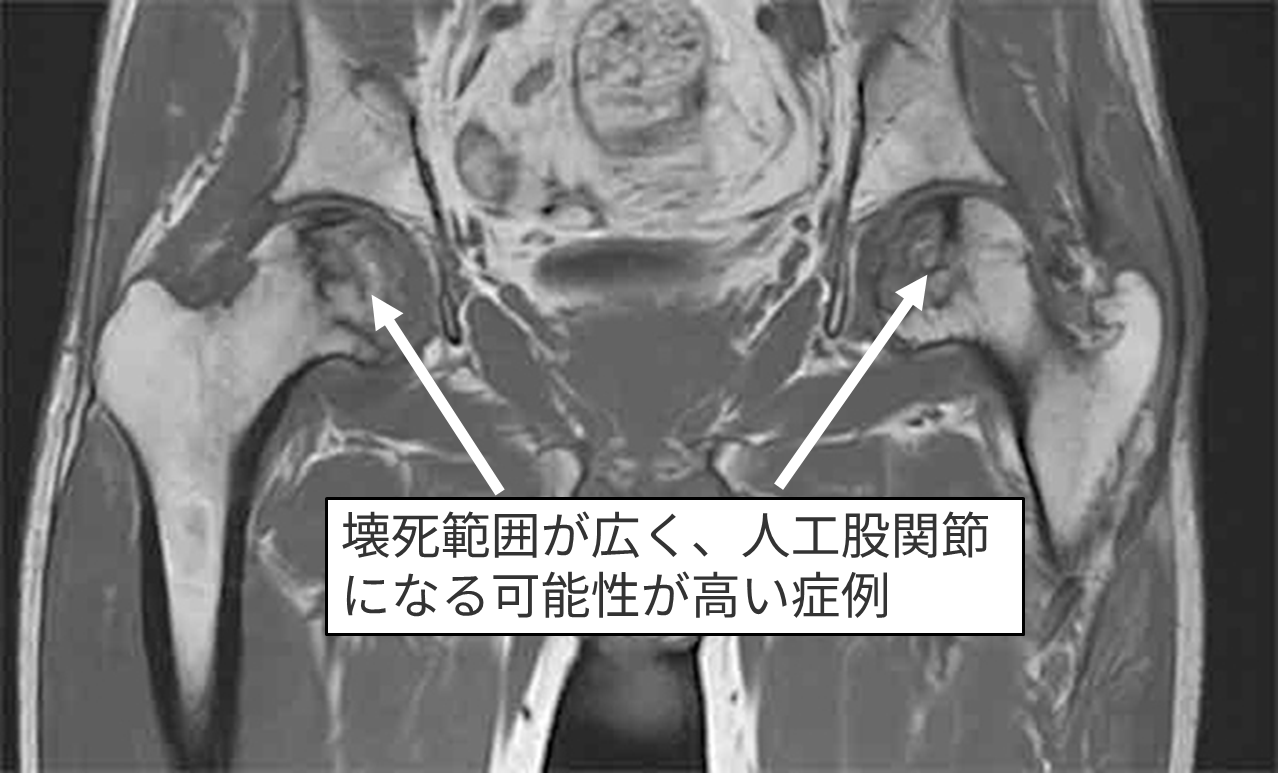
MRI at the first visit Tap or click to enlarge ↗
Condition at the First Visit
Treatment History
Previous steroid treatment
Lifestyle
Alcohol: 2 glasses of chuhai (shochu highball) a day Smoking: 10 cigarettes a day
MRI Findings
Classification
Right
Left
Type
Type C1
Type C1
Stage
Stage 2
Stage 3A
Type and stage are classifications that describe the extent of the necrosis and the condition of the bone. The doctor decides whether a treatment is appropriate, taking symptoms and test results into account.
01
Diagnosed with osteonecrosis of the femoral head on both sides
→
02
Came to the clinic seeking regenerative medicine
→
03
Had surgery involving regenerative medicine on both hips
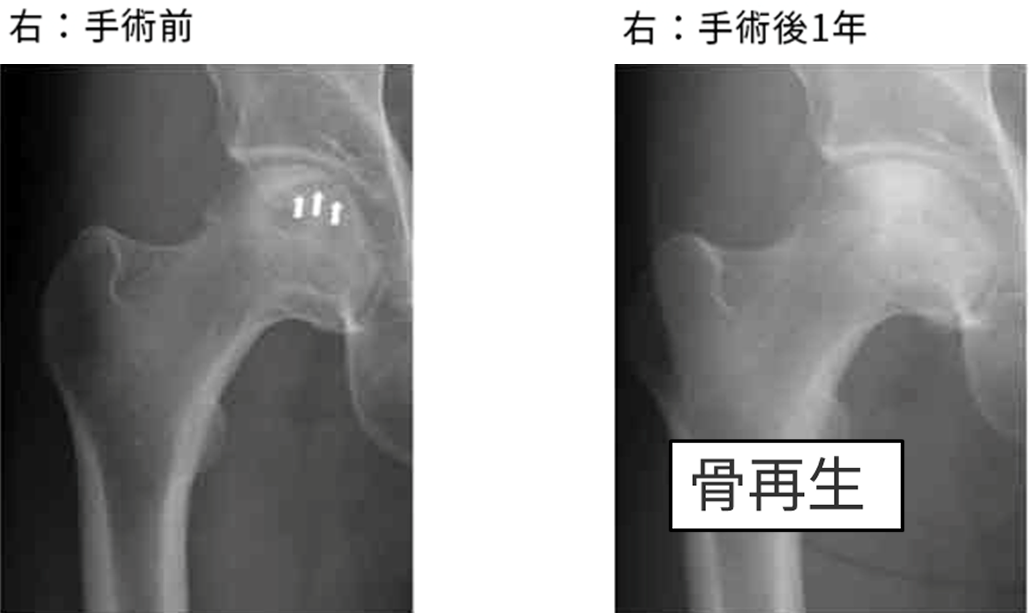
Images Before and After Treatment
X-rays of each hip, before surgery and 1 year after
Right hipBefore surgery → 1 year after
Tap or click to enlarge ↗
Left hipBefore surgery → 1 year after
Tap or click to enlarge ↗
Which treatments are suitable, and how patients progress after treatment, differ from person to person. Based on your examination and tests, we explain the treatment that suits you.
PhD in Medicine (Kyoto University)Board-Certified Orthopedic SurgeonDesignated Physician for Intractable Diseases
Dr. Kuroda's work has centered on research into osteonecrosis of the femoral head and clinical practice in joint surgery. After completing his studies at the Kyoto University Graduate School of Medicine, he held positions including lecturer in the Department of Orthopaedic Surgery at Kyoto University before opening Rejoint Clinic.
He starts by reviewing your symptoms and test results, then asks about your wishes and explains the treatment options.
Yes. You don't have to bring MRI images, but if you have images or test results, please bring them. Not having to bring images doesn't mean an MRI is unnecessary for diagnosis. The doctor decides which tests you need.
What is the difference between a free phone consultation and an in-person visit?
In a free phone consultation, the medical director asks about your condition and explains the treatment options that may be available. At an in-person visit, we do X-rays, ultrasound, blood tests and other tests as needed, and the doctor decides on a treatment plan. A phone consultation alone cannot confirm whether a treatment is suitable for you.
Is my appointment confirmed when I send a request online?
No. The online form sends us your request and preferred times. Our staff will then call you within two clinic days (not counting days the clinic is closed) to arrange the date and time, and your appointment is confirmed after that.
Can I discuss options other than joint replacement?
Yes. We listen to your wishes and explain the options based on your examination and test results. Depending on your condition, joint replacement surgery or another treatment may be appropriate, and we refer you to a partner hospital when needed.
Can I see the doctor on Sundays?
Yes, the clinic sees patients on Sundays. However, it may be closed on some Sundays or for part of the day, so please ask when you make your appointment.
ACCESS
Location & Clinic Hours
〒105-0004 3-1-9 Shimbashi, Minato-ku, Tokyo, Japan 7F, 301 Shimbashi Building
By appointment only. The clinic may close on short notice. When we call you after you send your request, you can also check which days the clinic is open.
We will call you within two clinic days (not counting days the clinic is closed). Your appointment is confirmed once we agree on a date and time by phone.
REGENERATIVE MEDICINE
Regenerative Medicine
At your examination, we explain each treatment and whether it suits you.